
Buying clothes online is convenient, but sizing remains one of the biggest reasons garments fail to meet expectations. A shirt labelled medium can fit comfortably in one brand and feel restrictive in another. A dress may match the listed bust measurement but still sit awkwardly at the shoulders or waist.
The problem is that clothing sizes are not universal measurements. They are labels used by individual brands, often based on different fit models and design preferences.
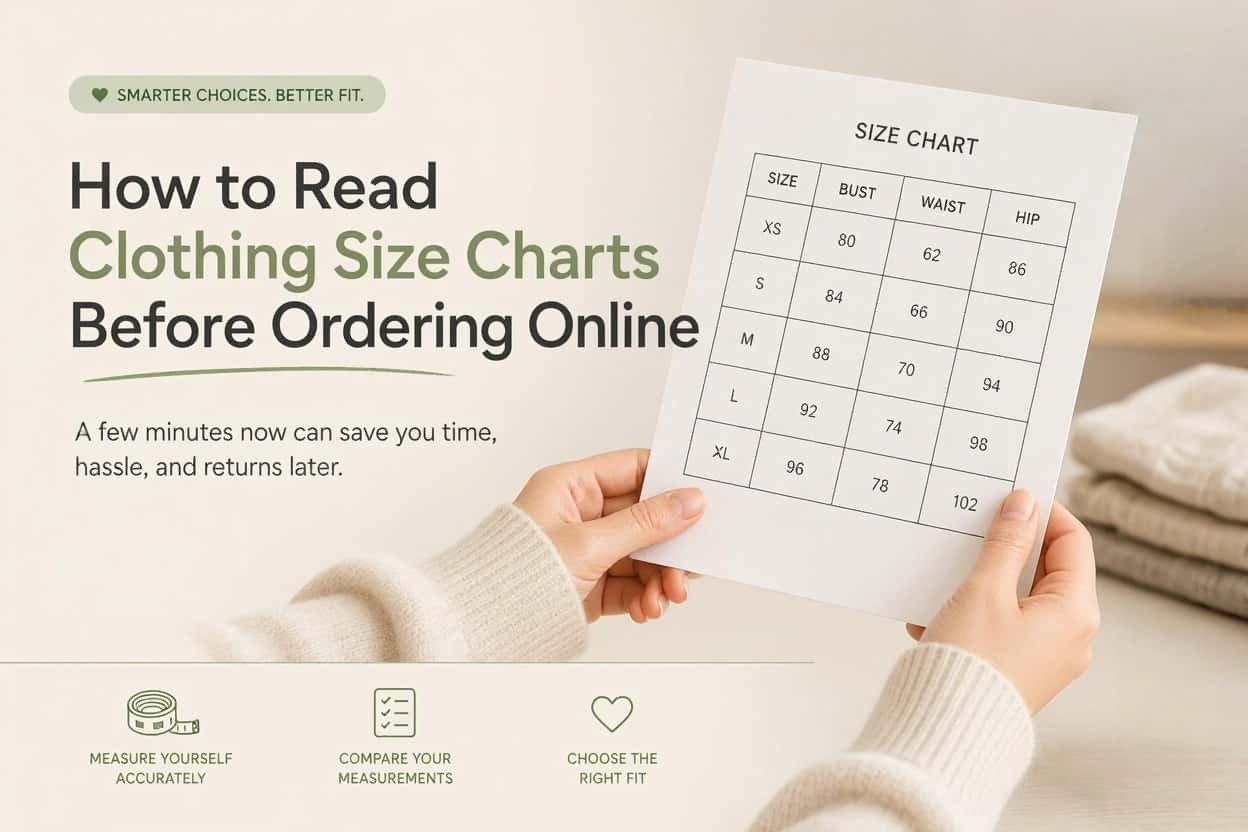
Learning how to read a size chart can reduce guesswork and make online purchases more predictable.
Understand body measurements and garment measurements
The first thing to check is whether a size chart shows body measurements or actual garment dimensions.
Body measurements describe the person the clothing is intended to fit. For example, a chart may recommend a particular size for a certain chest circumference or waist measurement.
Garment measurements describe the finished item itself. A shirt may measure considerably more than the wearer’s chest because it includes additional room for movement and comfort.
Confusing these two types of measurement can lead to incorrect decisions. If a product page does not explain which measurements are being provided, check its sizing notes or contact the seller.
Take measurements carefully
A flexible measuring tape is useful for checking the chest, waist, hips, shoulders, and inseam.
For chest measurements, place the tape around the fullest part of the chest while keeping it level across the back. Avoid pulling it too tightly.
The waist measurement should be taken around the area where the body naturally bends or where the garment is intended to sit. This may differ from the position of a particular trouser waistband.
Hip measurements are generally taken around the fullest part of the hips. For trousers and skirts, this measurement can be especially important because the garment needs enough room to move comfortably.
Shoulder width can be harder to measure accurately without assistance. If the product chart includes it, compare the measurement with a garment that fits well.
For inseam length, measure from the crotch seam to the bottom of the leg along the inside.
Measurements should be taken while standing naturally. Holding the measuring tape too tightly or changing posture can produce misleading results.
Do not assume that one size works across all garment types
A person may wear one size in a relaxed sweatshirt and another in a fitted blazer.
Different garments are designed with different amounts of ease. A close-fitting shirt may have limited additional room, while an oversized coat is intentionally cut with extra space.
The same applies to trousers. Stretch denim, tailored trousers, and loose linen pants have different fit expectations.
This is why it is more useful to compare measurements within the same garment category rather than treating one familiar size as a universal answer.
Learn what fit descriptions actually mean
Terms such as slim, regular, relaxed, and oversized describe the intended silhouette, but their interpretation can vary by brand.
Slim-fit clothing usually follows the body more closely. Regular-fit garments offer a moderate amount of room, while relaxed-fit designs provide additional space through selected areas.
Oversized clothing is intentionally generous in proportion. It should not necessarily be interpreted as a standard garment purchased several sizes larger.
Look for photographs that show how the clothing falls around the shoulders, waist, and legs. Product measurements are more useful when combined with clear images.
Check fabric composition
Fabric composition can change the way a garment behaves.
Cotton woven shirts often have limited stretch unless they contain elastane or use a special construction. Knitted fabrics may provide more natural flexibility.
A small amount of elastane can improve movement in trousers or fitted tops. However, the presence of stretch does not automatically mean that a garment will fit comfortably if its basic measurements are incorrect.
Linen may relax slightly during wear, while some wool garments have a more structured feel. The exact behavior depends on construction, finishing, and care.
Read the composition label before making assumptions based on the product photograph.
Use customer reviews intelligently
Reviews can provide useful information that size charts do not explain.
Look for repeated comments about the same issue. If several customers mention narrow shoulders, short sleeves, or a waistband that runs small, the pattern may be worth considering.
Reviews are most useful when the customer provides measurements or explains which size they purchased. A comment such as “fits perfectly” is less informative without additional context.
Be cautious about applying another person’s experience directly to your own body. Different proportions can produce different results even when two people have similar overall measurements.
Pay attention to international sizing
International clothing labels may use different systems. A size 8 in one country does not necessarily correspond exactly to a size 8 elsewhere.
European, US, UK, and Asian sizing systems are not always interchangeable. Even conversion tables are only approximate because individual brands use different measurement standards.
The safest approach is to use the measurements in centimetres or inches rather than relying entirely on converted size labels.
Also check whether the retailer provides separate charts for men’s, women’s, unisex, or children’s garments.
Consider the return policy before ordering
Even careful measurement cannot guarantee a perfect fit. Fabric behavior, garment construction, and individual body proportions all affect the final result.
Before purchasing, check the return period, whether sale items are excluded, and who pays for return shipping. International orders may involve additional costs or restrictions.
For expensive garments, it may be worth asking the retailer for additional measurements, especially around the shoulders, sleeve length, rise, or garment length.
Keep a record of what fits
A simple personal sizing note can save time during future purchases.
Record your measurements and the dimensions of garments that fit well. Include the brand, garment type, size label, and any useful observations.
Over time, this becomes more reliable than repeatedly guessing based on familiar size names.
Online shopping becomes much easier when measurements are treated as practical information rather than complicated technical details. A few minutes spent checking a size chart can prevent the inconvenience of receiving clothing that looks right online but feels wrong in everyday use.